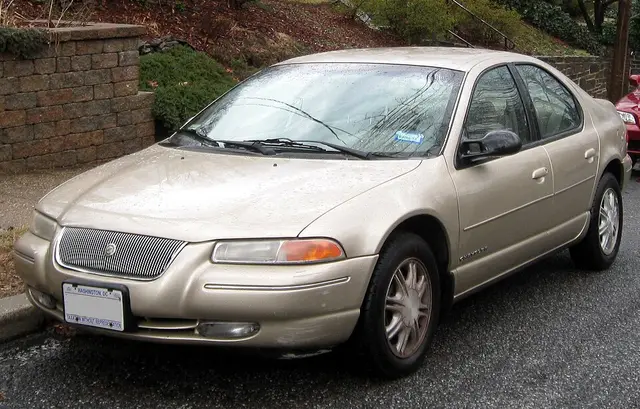
1996 Chrysler Cirrus Problems, Complaints & Recalls
- Compared with other Cirrus years
- Far more complaints than other years 2nd of 7 for complaints
- Safety recalls
- 7 recalls: check your VIN
- NHTSA crash rating
- Not rated
Owners have filed 160 complaints with NHTSA about the 1996 Chrysler Cirrus. That ranks 2nd out of 7 Cirrus model years for complaints. The most reported problem area is engine and engine cooling (38 complaints, 24%), typically at around 69,892 miles. Complaints mention 10 crashes, 5 fires, 11 injuries. There are 7 safety recalls covering this model year. NHTSA has opened 2 defect investigations involving it.

- 160owner complaints
- 7safety recalls
- 2NHTSA investigations
- 10complaints mentioning a crash
Complaints are unverified owner reports and are not adjusted for sales volume.
Most common 1996 Chrysler Cirrus problems
Complaints grouped by the part of the car owners reported, with the median mileage when the problem happened.
| Problem area | Complaints | Share | Median miles | Owners mention most | Typical repair cost |
|---|---|---|---|---|---|
| Engine and Engine Cooling | 38 | 24% | 69,892 | — | — |
| Power Train | 22 | 14% | 91,960 | — | — |
| Service Brakes, Hydraulic | 22 | 14% | 52,500 | — | — |
| Electrical System | 18 | 11% | 117,253 | — | — |
| Suspension | 18 | 11% | 112,500 | — | — |
| Vehicle Speed Control | 14 | 9% | — | — | — |
| Steering | 13 | 8% | 80,000 | — | — |
| Equipment | 9 | 6% | 127,505 | — | — |
| Structure | 7 | 4% | 135,000 | — | — |
| Air Bags | 4 | 3% | 180,000 | — | — |
| Visibility | 4 | 3% | 97,500 | — | — |
| Fuel System, Gasoline | 3 | 2% | 131,253 | — | — |
| Latches/locks/linkages | 3 | 2% | 127,505 | — | — |
| Tires | 3 | 2% | — | — | — |
| Unknown or Other | 3 | 2% | — | — | — |
| Parking Brake | 2 | 1% | 45,000 | — | — |
| Seat Belts | 2 | 1% | 180,000 | — | — |
| Seats | 2 | 1% | 125,000 | — | — |
| Engine | 1 | 1% | 107,000 | — | — |
| Exterior Lighting | 1 | 1% | — | — | — |
| Interior Lighting | 1 | 1% | — | — | — |
| Service Brakes, Air | 1 | 1% | — | — | — |
One complaint can list several problem areas, so shares can add up to more than 100%.
Complaints by year received
1996 Chrysler Cirrus recalls (7)
Tap a recall to see the problem, the risk and the fix.
Power train:automatic transmission:lever and linkage:floor shift
Problem: On certain passenger vehicles, the floor shifter ignition-park interlock may fail and allow the shifter to be moved out of the park position with the key removed. An inoperative interlock may also allow the key to be removed when the shifter has not been placed in the park position.
Risk: Either circumstance may result in the vehicle rolling away without warning.
Fix: Dealers will install a new load-limiting push rod into the floor shifter lever of the affected vehicles. Owner notification began on june 14, 2004. Owners should contact daimlerchrysler at 1-800-853-1403.
Power train:automatic transmission:park/neutral start interlock switch
Problem: Vehicle description: passenger vehicles equipped with automatic transmissions. The adjustment of the cable connecting the console shifter mechanism to the ignition key can cause a trapped key condition which can result in a low force required to depress the shift button. A combination of applying a mis-adjusted release button with a low force attempt to shift out of park with the key in the locked position, can break the connecting pin in the shifter.
Risk: If this happens, the "ignition-park" interlock system will be nonfunctional.
Fix: Dealers will inspect for proper operation of the system. Any vehicles that are not functional after the inspection will have the shift mechanism and cable replaced with a "self-adjusting" design.
Suspension:front:control arm:lower ball joint
Problem: Vehicle description: passenger vehicles. The lower control arm ball joint can separate due to loss of lubrication.
Risk: Separation of the ball joint could cause a loss of steering control increasing the risk of a vehicle crash.
Fix: Dealers will inspect the ball joint end housing cover seal for leakage with a high pressure air tester and the rubber boot will be visually inspected for damage. If the cover seal leaks or the boot is damaged, the lower control arm will be replaced.
Structure:body:hood:hinge and attachments
Problem: Vehicle description: passenger vehicles. The secondary hood latch spring can disengage from its retention hole if the hood is slammed shut.
Risk: If this condition occurs simultaneously without engaging the primary latch, the hood would not be restrained increasing the risk of a vehicle crash.
Fix: Dealers will replace the secondary hood latch spring with a longer end hook spring.
Service brakes, hydraulic:foundation components:master cylinder
Problem: The brake master cylinder can leak brake fluid due to a damaged double lip rear piston seal.
Risk: Brake fluid leakage can result in diminished effectiveness of one half of the split brake system. The instrument panel warning light(s) will signal system impairment prior to partial brake system loss.
Fix: Dealers will replace the rear brake master cylindr piston assembly.
Service brakes, hydraulic:antilock/traction control/electronic limited slip
Problem: Corrosion of the abs hydraulic control unit can cause the solenoid valves to stick in the open position.
Risk: If either front wheel valve sticks, the vehicle would swerve from a straight stop when the brakes are applied.
Fix: Dealers will install a plate and silicone grease injected into the solenoid cavity to eliminate the potential for this condition.
Engine and engine cooling:engine:gasoline
Problem: In certain vehicles, the engine cylinder head oil galley plug does not seal properly and engine cylinder head oil is not adequately retained.
Risk: Inadequate sealing and retention of the plug can result in oil leakage which could cause a fire in the engine compartment.
Fix: Dealers will install an expansion plug and retaining bracket over the cylinder head oil galley plug.
To see whether a specific car still has an open recall, enter its VIN on NHTSA's official recall lookup. You can also decode a VIN here.
NHTSA defect investigations
- Auto trans ignition-park interlock (EA03011) — opened Jul 17, 2003, closed Jan 30, 2004, led to recall 04V021000.
- Lower control arm ball joint failure (EA97016) — opened Sep 29, 1997, closed Nov 20, 1997, led to recall 97V201000.
Recent owner reports
Short excerpts of the latest complaints filed with NHTSA, with personal details removed. Full reports can be searched on NHTSA.gov.
My front tires feel like they are going to break off the vehicle due to the lower ball joints,steering control arm, inner and outer tie rods; accelerates all by itself. Will not lock shifter with key out of ignition. Ecm is faulty because it shuts the lights off,turns engine,all lights, off…
My 1996 cirrus with only 87+++ miles suddenly downshifts while driving over 40 mph. This is a recent purchase. I live in wyoming and it is winter time with icy road conditions nearly everywhere. I am a single mother with a 10 year old daughter. When this happened to us on the highway, it caused us…
Tl* the contact owns a 1996 chrysler cirrus. The contact stated that while the vehicle was parked, there was smoke seen from the engine compartment. The contact also noticed that there was oil leaking onto the ground. The fire was extinguished using a fire extinguisher. The dealer was contacted and…
Tl* the contact owns a 1996 chrysler cirrus. The contact stated that the rear lateral link fractured, causing the rear driver side tire to fold inward while driving 10 mph. The contact did not take the vehicle to the dealer or local mechanic for repairs or diagnostics. The failure mileage was…
Tl* the contact owns a 1996 chrysler cirrus. The contact stated that the driver was traveling 42 mph when the steering wheel became excessively loose. This made it difficult for the driver to maintain control of the vehicle. The vehicle independently veered off the road, and crashed into a electric…
Other Chrysler Cirrus years
| Year | Complaints | Recalls |
|---|---|---|
| 2001 Cirrus | 1 | 0 |
| 2000 Cirrus | 99 | 5 |
| 1999 Cirrus | 62 | 3 |
| 1998 Cirrus | 69 | 3 |
| 1997 Cirrus | 69 | 4 |
| 1996 | 160 | 7 |
| 1995 Cirrus | 369 | 7 |
See all Chrysler Cirrus problems by year, every Chrysler model, or the Chrysler VIN decoder.
Similar Chrysler models
Embed this 1996 Chrysler Cirrus badge on your site
Copy this code into your blog or forum post. It shows live complaint and recall counts and links back here.
Frequently asked questions
What are the most common problems with the 1996 Chrysler Cirrus?
Owners most often report engine and engine cooling, power train, service brakes, hydraulic problems. The top one, engine and engine cooling, accounts for 38 complaints.
Was there a recall on the 1996 Chrysler Cirrus?
Yes, 7 safety recalls. Enter your VIN at NHTSA.gov to check whether the repairs were done on your car.
Was the 1996 Chrysler Cirrus a good year?
Complaint data can't fully answer that, because counts aren't adjusted for sales. Compared with other Cirrus model years, the 1996 has far more complaints than most years. Always get a pre-purchase inspection and check the VIN for open recalls.