Ford Windstar Power Train Problems
Owners have filed 2,595 complaints with NHTSA about power train problems on the Ford Windstar across 10 model years. The 1995 model year has the most (875). The words owners use most often: “rear axle” (10% of reports).
- 2,595power train complaints
- —median miles at failure
- 68mention a crash
- 32mention an injury
- 4related recalls
- $3,500typical repair cost reported by owners
- 33%of reports with a speed happened at 50+ mph
What owners describe
Phrases that appear unusually often in these complaints compared with complaints about other cars.
- Rear axle: mentioned in 250 of 2,595 complaints (10%)
- Transmission failed: mentioned in 246 of 2,595 complaints (9%)
- Head gasket: mentioned in 159 of 2,595 complaints (6%)
How much does it cost to fix?
Owners who wrote down what they paid or were quoted put the typical power train repair on the Ford Windstar at $3,500, and half of them between $1,850 and $4,400.
Based on 159 NHTSA complaints about this problem alone that state a repair bill or quote (1998–2015), converted to 2026 dollars with the U.S. consumer price index. These are owners' own figures, not a quote: they include dealer quotes, and owners who file complaints often faced larger repairs, so they can run higher than typical shop prices. Prices vary by shop, region and warranty coverage. How we calculate this.
At what mileage do power train problems happen?
Based on 930 complaints that reported the odometer reading.
How serious are the reports?
Of 2,595 complaints, 68 mention a crash, 38 a fire, 32 an injury.
Ford Windstar power train complaints by model year
| Model year | Power Train complaints | Share of that year | Median miles |
|---|---|---|---|
| 2004 Windstar | 7 | 29% | 122,414 |
| 2003 Windstar | 225 | 15% | 102,000 |
| 2002 Windstar | 97 | 7% | 113,200 |
| 2001 Windstar | 145 | 9% | 106,574 |
| 2000 Windstar | 271 | 16% | 86,175 |
| 1999 Windstar | 278 | 18% | 74,250 |
| 1998 Windstar | 332 | 23% | 89,000 |
| 1997 Windstar | 43 | 22% | 146,000 |
| 1996 Windstar | 322 | 23% | 72,000 |
| 1995 Windstar | 875 | 26% | 93,672 |
When owners reported it
Related recalls (4)
Power train:axle assembly
Model years: 1998, 1999, 2000, 2001, 2002, 2003
Problem: Ford is recalling certain model year 1998-2003 windstar vehicles manufactured from september 1, 1997, through july 3, 2003, and currently registered or originally sold in virginia. Over time, corrosion can weaken the rear axle making it susceptible to torsional stress. Corrosion and stress can lead to cracks which, if undetected, can increase and result in a complete fracture of the axle.
Risk: A fractured axle can affect vehicle handling and increase the risk of a crash.
Fix: Ford will notify owners, and dealers will inspect and install rear axle reinforcement brackets, or replace the axles, as necessary. This service will be performed free of charge. The recall began on june 19, 2012. Owners may contact ford at 1-866-436-7332.
Power train:automatic transmission
Model years: 1997, 1998
Problem: Vehicle description: passenger vehicles equipped with ax4s automatic transaxles. The low/intermediate servo cover can separate from the transaxle while the vehicle is being driven. If this occurs, transmission fluid will leak contacting the catalytic converter.
Risk: The catalytic converter temperature may be hot enough to ignite the transmission fluid and cause a vehicle fire.
Fix: Dealers will inspect the transmission and replace these servo covers.
Power train:automatic transmission:gear position indication (prndl)
Model years: 1996
Problem: The park pawl abutment bracket has a sharp edge which can cause the parking pawl to hang up and not engage the park gear. This would allow the vehicle to move even though the gear shift indicator shows that the vehicle is in park.
Risk: Unintended and unexpected vehicle movement can result in personal injury and property damage.
Fix: Dealers will inspect and, if necessary, replace the park pawl abutment bracket.
Power train:automatic transmission
Model years: 1996
Problem: The park pawl shaft was improperly positioned when the roll pin that retains it was installed during transmission assembly. If the shaft was not properly positioned, the roll pin may not have lined up with the groove in the shaft and have been crushed at assembly. Also, a burr could have been raised on the shaft.
Risk: This could result in the park pawl occasionally not engaging when the transmission selector lever is placed in the park position. This could result in the vehicle rolling as if in neutral if the vehicle operator does not apply the parking brake.
Fix: Dealers will inspect the park pawl shaft roll pin. If the roll pin is damaged, both the roll pin and the park pawl shaft will be replaced. In addition, owners will be reminded to fully apply the parking brake, in addition to placing the transmission in park.
What owners report
Short excerpts of recent complaints, with personal details removed. Full reports are on NHTSA.gov.
The contact owns a 1999 Ford Windstar. The contact stated while driving 5 MPH out of the driveway, the vehicle made an abnormal grinding and popping sound. The contact shifted to park(P). The contact stated that upon inspecting the vehicle, the contact noticed that the rear passenger's side tire…
The contact owns a 2002 Ford Windstar. The contact stated that while driving approximately 30 MPH, there was an abnormally loud sound coming from the rear of the vehicle. The contact lost control of the vehicle and drove off the side of the roadway. The vehicle was later towed to the local mechanic…
My family and I went to pull out of an entersection when the 03 Ford Windstar I purchased suddenly stopped pulling .almost getting rearended
On May 23rd 2022 I was driving on interstate 45 the speed limit through where I was driving was 75 all of a sudden with no warning no engine light on my transmission stopped working and I could not break I was able to safely get over thank goodness but there is a recall on my transmission which…
Rear axle snapped in half with no warning as i was driving about 40 mph on a busy road. Very dangerous.
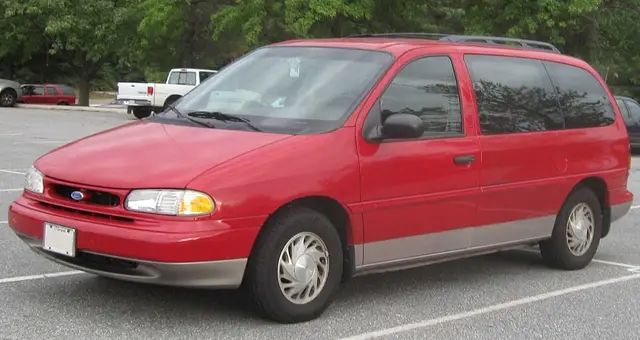
Frequently asked questions
Do all Ford Windstars have power train problems?
No. NHTSA has 2,595 owner complaints about power train for the Ford Windstar. Complaint data shows that the problem is reported, not how many of all cars sold are affected.
Was there a recall on the Ford Windstar power train?
Yes: 4 safety recalls list power train. Check your VIN on NHTSA.gov to see whether the fix was done on your car.
How much does it cost to fix power train problems on the Ford Windstar?
Owners report a typical cost of $3,500 (half paid between $1,850 and $4,400), from 159 complaints that state a repair bill or quote, in 2026 dollars.
What do owners say about power train problems on the Ford Windstar?
The most frequent phrase is “rear axle”, in 250 of 2,595 complaints, followed by “transmission failed” (246).
Other Ford Windstar problems
- Engine and Engine Cooling problems (2,676)
- Service Brakes, Hydraulic problems (2,137)
- Suspension problems (2,045)
- Electrical System problems (1,567)
- Structure problems (1,239)
- Service Brakes problems (929)
- Vehicle Speed Control problems (892)
- Steering problems (682)
See all Ford Windstar problems.