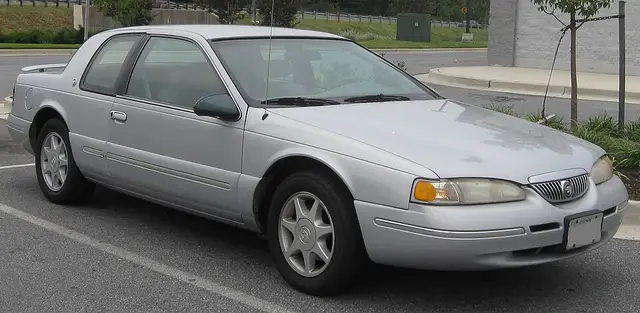
1999 Mercury Cougar Problems, Complaints & Recalls
- Compared with other Cougar years
- Far more complaints than other years 1st of 8 for complaints
- Safety recalls
- 7 recalls: check your VIN
- NHTSA crash rating
- Not rated
Owners have filed 454 complaints with NHTSA about the 1999 Mercury Cougar. That is the most of any Cougar model year in the database (8 years). The most reported problem area is electrical system (99 complaints, 22%), typically at around 70,132 miles. Complaints mention 23 crashes, 3 fires, 27 injuries. There are 7 safety recalls covering this model year. NHTSA has opened 1 defect investigation involving it.

- 454owner complaints
- 7safety recalls
- 1NHTSA investigations
- 23complaints mentioning a crash
Complaints are unverified owner reports and are not adjusted for sales volume.
Most common 1999 Mercury Cougar problems
Complaints grouped by the part of the car owners reported, with the median mileage when the problem happened.
| Problem area | Complaints | Share | Median miles | Owners mention most | Typical repair cost |
|---|---|---|---|---|---|
| Electrical System problems | 99 | 22% | 70,132 | “provide further” (8%) | — |
| Service Brakes, Hydraulic problems | 72 | 16% | 62,200 | “grinding noise” (10%) | — |
| Engine and Engine Cooling problems | 67 | 15% | 79,000 | — | — |
| Visibility problems | 52 | 11% | 56,000 | “sun roof” (13%) | $2,750 |
| Power Train problems | 50 | 11% | 75,750 | — | — |
| Fuel System, Gasoline | 39 | 9% | 69,500 | — | — |
| Exterior Lighting | 34 | 7% | 83,246 | — | — |
| Structure | 34 | 7% | 89,899 | — | — |
| Air Bags | 31 | 7% | 65,000 | — | — |
| Vehicle Speed Control | 31 | 7% | 64,185 | — | — |
| Tires | 27 | 6% | 19,260 | — | — |
| Unknown or Other | 26 | 6% | 132,450 | — | — |
| Suspension | 22 | 5% | 70,717 | — | — |
| Steering | 20 | 4% | 89,000 | — | — |
| Equipment | 15 | 3% | — | — | — |
| Latches/locks/linkages | 15 | 3% | 141,000 | — | — |
| Seats | 13 | 3% | 80,000 | — | — |
| Wheels | 7 | 2% | 76,000 | — | — |
| Seat Belts | 5 | 1% | 50,200 | — | — |
| Fuel System, Other | 4 | 1% | 53,500 | — | — |
| Engine | 3 | 1% | 97,000 | — | — |
| Fuel/propulsion System | 3 | 1% | 117,000 | — | — |
| Interior Lighting | 3 | 1% | — | — | — |
| Service Brakes, Air | 3 | 1% | 98,000 | — | — |
| Electronic Stability Control (esc) | 2 | 0% | 116,000 | — | — |
| Service Brakes | 2 | 0% | 147,500 | — | — |
| Back Over Prevention | 1 | 0% | — | — | — |
One complaint can list several problem areas, so shares can add up to more than 100%.
Complaints by year received
1999 Mercury Cougar recalls (7)
Tap a recall to see the problem, the risk and the fix.
Fuel system, gasoline
Problem: On certain passenger vehicles, contamination of the filter in the fuel delivery module (fdm) can reduce, and eventually block, the flow of fuel to the engine.
Risk: This may cause engine hesitation, loss of power, surging, and other similar symptoms. Over time, the filter may become sufficiently blocked to cause the engine to stall, which could result in a crash.
Fix: This action is deemed a safety improvement campaign and is not being conducted under the safety act. All owners will be notified of the problem, and dealers will replace the fdm with a new design at no charge if the owner reports that the vehicle exhibits any of the identified symptoms. The free replacement will be available for a period of 10 years following the original purchase of the vehicle, with no mileage limit. The campaign began on april 16, 2004. Owners should contact ford at 1-800-392-3673.
Electrical system
Problem: On certain my 1996-1998 passenger vehicles built at the kansas city, cuautitlan assembly plants or on my 1999 passenger vehcles built at the automotive alliance international assembly plants, the rough surface of the heater blower resistor's stainless steel blades can damage the copper surface of the wiring harness connector. The damage could, over time, cause increased resistance in the connector and, due to subsequent terminal relaxation, result in an open circuit condition.
Risk: The open circuit could lead to electrical arcing that could melt the connector housing material creasing the potential for a fire.
Fix: Dealers will install a new heater blower resistor and a new wire jumper harness. Owner notification began august 29, 2001. Owners who take their vehicles to an authorized dealer on an agreed upon service date and do not receive the free remedy within a reasonable time should contact ford at 1-800-392-3673.
Electrical system:12v/24v/48v battery:cables
Problem: Vehicle description: passenger vehicles equipped with 2.5l v6 engines. The battery cable was misrouted and its attachment to the alternator cable was under-torqued. If misrouted, the cable could contact the power steering line and the insulation could wear, resulting in an electrical short.
Risk: The short could potentially result in a fire, stalling, or a no-start condition.
Fix: Dealers will inspect the battery cable to the alternator for damage and, if it is damaged, will replace the cable. Additionally, the routing of the cable will be corrected, as necessary, and a routing clip will be added. Also the torque on the alternator attachment of the cable will be checked and, as required, will be tightened to specification. Owner notification began march 22, 2001. Owners who take their vehicles to an authorized dealer on an agreed upon service date and do not receive the free remedy within a reasonable time should contact ford at 1-800-392-3673.
Exterior lighting:brake lights:switch
Problem: Vehicle description: passenger vehicles. The brake lamp switch terminals could overheat.
Risk: This could cause either a loss of brake lamp function or continuously illuminated brake lamps, increasing the risk of a crash.
Fix: Dealers will install a new stop lamp extension harness with bronze terminals at the brake lamp switch connector, and also inspect the brake lamp switch for signs of overheating and replace, as required. Owner notification began march 22, 2001. Owners who take their vehicles to an authorized dealer on an agreed upon service date and do not receive the free remedy within a reasonable time should contact ford at 1-800-392-3673.
Service brakes, hydraulic:foundation components
Problem: Vehicle description: passenger vehicles not equipped with the anti-lock braking system (abs). A pressure conscious reducing valve (pcrv) in the rear brakes may be subject to corrosion and result in malfunction, when operated in areas that use salt compounds on the roadway for de-icing or dust control.
Risk: If both pcrv's malfunction, vehicle handling could be adversely affected during braking as a result of the rear wheels locking, increasing the risk of a crash.
Fix: Dealers will install improved pcrv's in the rear brake system. This recall was expanded in september 2000 to include 1999 and 2000 ford contour, mercury mystique and cougar vehicles.
Latches/locks/linkages:doors:latch
Problem: Vehicle description: passenger vehicles. The door latch may have been manufactured with a latch pawl that has a coating which will swell in high humidity conditions. The latch pawl may then stick in the open or unlatched position.
Risk: The door would not latch when closed. If the vehicle is driven in this condition, it could potentially result in the door opening while the vehicle is in motion.
Fix: Dealers will install a revised side door latch.
Vehicle speed control
Problem: Vehicle description: passenger vehicles. The accelerator cable may have been manufactured with a burr on or near the end of the cable sleeve interior. This burr could fray the core wire resulting in the accelerator not returning to idle when the accelerator is released.
Risk: This condition can result in the throttle sticking, binding, or causing high engine rpm.
Fix: Dealers will install a revised accelerator cable that has a flared conduit sleeve end and molded on end fitting.
To see whether a specific car still has an open recall, enter its VIN on NHTSA's official recall lookup. You can also decode a VIN here.
NHTSA defect investigations
- Blower switch/resistor or wiring harness (EA01001) — opened Jan 5, 2001, closed Jul 31, 2001, led to recall 01I009000.
Recent owner reports
Short excerpts of the latest complaints filed with NHTSA, with personal details removed. Full reports can be searched on NHTSA.gov.
Yes, i purchased my vehicle in july of 2017. When i test drove the vehicle, everything seemed perfectly fine. Yet, the day i received it, i went to the gas station to fill up. Upon returning home, 1 mile., the engine light came on. I was told by the seller all was perfectly fine. Drive the car, it…
I got in my car one day after work in the parking lot and started my car and my airbag light was on. It stayed on for three days and is no longer on. It seems like no one wants to take account or provide solutions for the problem. Everytime i roll up my windows, my lights dim as if the battery is…
Transmission having problems going into gear constantly slipping and catching gears when trying to drive only gets up to 30 mph
Calipers constantly falls off causing wheel to lock up
I have problem with transmmition shifting 1st to second changes at 3000rpm but when i change park to drive shakes motor bad , one of the wires start smoking i like i put tape around wired burnd. Temperature it doesn't show but when i open the hood the car is very hot every time i tried driving it…
Other Mercury Cougar years
| Year | Complaints | Recalls |
|---|---|---|
| 2002 Cougar | 95 | 1 |
| 2001 Cougar | 82 | 1 |
| 2000 Cougar | 211 | 3 |
| 1999 | 454 | 7 |
| 1998 Cougar | 1 | 0 |
| 1997 Cougar | 76 | 0 |
| 1996 Cougar | 62 | 2 |
| 1995 Cougar | 109 | 0 |
See all Mercury Cougar problems by year, every Mercury model, or the VIN decoder.
Similar Mercury models
Embed this 1999 Mercury Cougar badge on your site
Copy this code into your blog or forum post. It shows live complaint and recall counts and links back here.
Frequently asked questions
What are the most common problems with the 1999 Mercury Cougar?
Owners most often report electrical system, service brakes, hydraulic, engine and engine cooling problems. The top one, electrical system, accounts for 99 complaints.
Was there a recall on the 1999 Mercury Cougar?
Yes, 7 safety recalls. Enter your VIN at NHTSA.gov to check whether the repairs were done on your car.
Was the 1999 Mercury Cougar a good year?
Complaint data can't fully answer that, because counts aren't adjusted for sales. Compared with other Cougar model years, the 1999 has far more complaints than most years. Always get a pre-purchase inspection and check the VIN for open recalls.