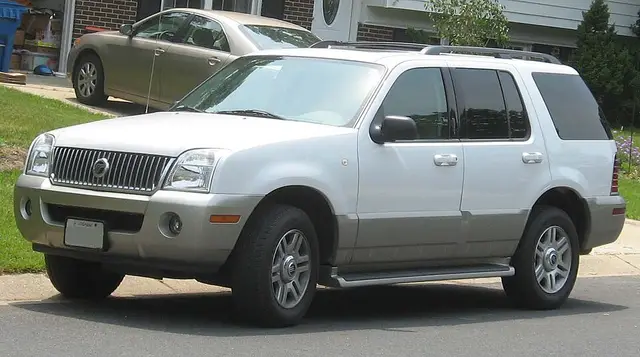
1997 Mercury Mountaineer Problems, Complaints & Recalls
- Compared with other Mountaineer years
- Far more complaints than other years 2nd of 15 for complaints
- Safety recalls
- 6 recalls: check your VIN
- NHTSA crash rating
- Not rated
Owners have filed 328 complaints with NHTSA about the 1997 Mercury Mountaineer. That ranks 2nd out of 15 Mountaineer model years for complaints. The most reported problem area is tires (138 complaints, 42%). Complaints mention 41 crashes, 10 fires, 19 injuries. There are 6 safety recalls covering this model year. NHTSA has opened 4 defect investigations involving it.

- 328owner complaints
- 6safety recalls
- 4NHTSA investigations
- 41complaints mentioning a crash
Complaints are unverified owner reports and are not adjusted for sales volume.
Most common 1997 Mercury Mountaineer problems
Complaints grouped by the part of the car owners reported, with the median mileage when the problem happened.
| Problem area | Complaints | Share | Median miles | Owners mention most | Typical repair cost |
|---|---|---|---|---|---|
| Tires problems | 138 | 42% | — | “p235 75r15” (36%) | — |
| Vehicle Speed Control problems | 59 | 18% | 109,500 | “suddenly accelerated” (8%) | — |
| Service Brakes, Hydraulic | 37 | 11% | 99,500 | — | — |
| Electrical System | 15 | 5% | 62,502 | — | — |
| Suspension | 15 | 5% | 144,500 | — | — |
| Engine and Engine Cooling | 14 | 4% | — | — | — |
| Seat Belts | 12 | 4% | 150,000 | — | — |
| Visibility | 11 | 3% | 95,000 | — | — |
| Structure | 9 | 3% | 59,800 | — | — |
| Power Train | 8 | 2% | 100,000 | — | — |
| Air Bags | 7 | 2% | — | — | — |
| Equipment | 7 | 2% | 59,800 | — | — |
| Latches/locks/linkages | 5 | 2% | 122,000 | — | — |
| Steering | 5 | 2% | — | — | — |
| Seats | 4 | 1% | — | — | — |
| Fuel System, Gasoline | 3 | 1% | 270,500 | — | — |
| Exterior Lighting | 2 | 1% | 90,000 | — | — |
| Fuel System, Other | 2 | 1% | — | — | — |
| Parking Brake | 2 | 1% | — | — | — |
| Unknown or Other | 2 | 1% | — | — | — |
| Wheels | 2 | 1% | — | — | — |
| Fuel/propulsion System | 1 | 0% | — | — | — |
| Interior Lighting | 1 | 0% | — | — | — |
| Service Brakes, Air | 1 | 0% | — | — | — |
One complaint can list several problem areas, so shares can add up to more than 100%.
Complaints by year received
1997 Mercury Mountaineer recalls (6)
Tap a recall to see the problem, the risk and the fix.
Vehicle speed control
Problem: Ford is recalling model years 1995-2003 windstar, 2000-2003 excursion diesel, 1993-1997 and 1999-2003 f-250 sd through f-550 sd diesel, 1992-2003 e-150 through e-550, 1995-2002 explorer, 1997 and 2002 mercury mountaineer, 1995-1997 and 2001-2003 ranger, and 1994 f53 vehicles equipped with the texas instruments speed control deactivation switch (scds). The scds may leak internally and then overheat, smoke, or burn.
Risk: A vehicle fire could occur with or without the engine running.
Fix: Ford will notify owners that dealers will install a fused wiring harness in line with the scds. On 1999-2003 windstar vehicles with a leaking scds, dealers will also inspect the abs control module connector and repair as necessary. Repairs will be completed free of charge. The safety recall began on october 27, 2009. Owners may contact ford at 1-888-222-2751.
Vehicle speed control
Problem: Vehicle description: sport utility vehicles equipped with 4.0l sohc engines and still retain the original throttle body (part numbers 97jf-9e926ab or 97jf-9e926-ac). Some of the original throttle bodies installed allowed a gap between the plate and bore to be built too narrow. This reduced clearance allowed the engine deposits normally present in the throttle body to contact or bridge the gap. If the engine deposits bridged the gap between the throttle plate and bore and then hardened, on the initial application of the accelerator pedal after the engine has cooled, the operator would need to apply additional force to the accelerator pedal to break the bridge.
Risk: This could result in engine surge when the accelerator pedal breaks free.
Fix: Dealers will replace the original throttle bodies.
Suspension
Problem: Vehicle description: sport utility vehicles. Under certain conditions, a front sway bar link can fracture.
Risk: Vehicle handling could be affected, increasing the risk of a crash.
Fix: Dealers will replace both the left and right front sway bar links.
Fuel system, gasoline:delivery:hoses, lines/piping, and fittings
Problem: Vehicle description: multi-purpose passenger vehicles equipped with 4.0l single overhead cam engines. The engine fuel lines can be damaged if the vehicle is jump started and the ground cable is attached to the fuel line bracket that is located near the battery. Since the bracket is not grounded, the stainless steel fuel line braid could act as a ground potentially overheating the ptfe inner liner of the fuel line resulting in damage to the fuel line.
Risk: The fuel lines can leak, and in the presence of an ignition source, a fire could potentially result.
Fix: Dealers will install a warning label on the fuel line bracket advising owners not to use it for a jump start ground. Also a revised bolt will be installed in the alternator bracket to provide a convenient jump start ground location.
Structure:body:hatchback/liftgate:support device/strut
Problem: Vehicle description: multi-purpose passenger vehicles. The liftgate assist gas cylinder bracket on the right hand bodyside outer panel was incorrectly welded.
Risk: The gas cylinder bracket may not properly support the liftgate increasing the risk of personal injury.
Fix: Dealers will reinforce the bracket attachment with two pop rivets.
Vehicle speed control
Problem: Vehicle description: multi-purpose passenger vehicles equipped with 5.0l engines originally sold or currently registered in the states of alaska, idaho, iowa, maine, michigan (upper peninsula only), minnesota, montana, nebraska, new hampshire, new york, north dakota, south dakota, vermont, wisconsin, and wyoming. These vehicles, when operated for extended periods of time at highway speeds and temperatures below -20 degrees farenheit, do not return to idle due to ice in the throttle body.
Risk: Although the vehicle can be controlled by either applying the service brakes or shifting the transmission to neutral, increased brake pedal efforts or some increase in stopping distance can result.
Fix: Dealers will install a revised pcv system with water heated vacuum source.
To see whether a specific car still has an open recall, enter its VIN on NHTSA's official recall lookup. You can also decode a VIN here.
NHTSA defect investigations
- Spark plug ejection from cylinder head (DP05005) — opened Sep 22, 2005, closed Jan 4, 2006.
- Windshield wiper malfunction (PE99049) — opened Jul 28, 1999, closed Apr 24, 2000, led to recall 00V072000.
- Steering knuckle separations (PE99045) — opened Jul 6, 1999, closed Oct 29, 1999.
- Fuel line damage from jump starting (RQ98020) — opened Nov 3, 1998, closed Nov 15, 2000, led to recall 98V060000.
Recent owner reports
Short excerpts of the latest complaints filed with NHTSA, with personal details removed. Full reports can be searched on NHTSA.gov.
Tl* the contact owns a 1997 mercury mountaineer. The contact stated while the vehicle was stationary, the vehicle stalled. The contact stated no warning light was illuminated. The vehicle was taken to an unknown dealer to be diagnosed. The contact was informed that the fuel pump needed to be…
Drivers side seat belt buckle will not latch. 185,000 miles.
Tl* the contact's husband owns a 1997 mercury mountaineer. The contact stated that when the brake pedal was released, the vehicle unintentionally accelerated. As a result, the contact's husband rear ended another vehicle. The air bags did not deploy. A police report was filed and there were no…
Driver side seat belt refuses to latch and, if it does latch, comes unlatched on its own. On inspection, the 'guts' of the mechanism are gone.
I was at a gas station making a purchase with my disabled mother. We left the store, and got into my truck. I started my truck and proceed to dive towards the exit of the gas station when i smelled something like burning rubber. I said to my mother that something smelled funny and then looked and…
Other Mercury Mountaineer years
← 1996 Mountaineer · 1998 Mountaineer →
| Year | Complaints | Recalls |
|---|---|---|
| 2010 Mountaineer | 13 | 1 |
| 2009 Mountaineer | 6 | 0 |
| 2008 Mountaineer | 96 | 1 |
| 2007 Mountaineer | 81 | 0 |
| 2006 Mountaineer | 117 | 1 |
| 2005 Mountaineer | 82 | 0 |
| 2004 Mountaineer | 210 | 0 |
| 2003 Mountaineer | 152 | 0 |
| 2002 Mountaineer | 372 | 2 |
| 2001 Mountaineer | 22 | 3 |
| 2000 Mountaineer | 123 | 6 |
| 1999 Mountaineer | 151 | 7 |
| 1998 Mountaineer | 236 | 5 |
| 1997 | 328 | 6 |
| 1996 Mountaineer | 3 | 1 |
See all Mercury Mountaineer problems by year, every Mercury model, or the VIN decoder.
Similar Mercury models
Embed this 1997 Mercury Mountaineer badge on your site
Copy this code into your blog or forum post. It shows live complaint and recall counts and links back here.
Frequently asked questions
What are the most common problems with the 1997 Mercury Mountaineer?
Owners most often report tires, vehicle speed control, service brakes, hydraulic problems. The top one, tires, accounts for 138 complaints.
Was there a recall on the 1997 Mercury Mountaineer?
Yes, 6 safety recalls. Enter your VIN at NHTSA.gov to check whether the repairs were done on your car.
Was the 1997 Mercury Mountaineer a good year?
Complaint data can't fully answer that, because counts aren't adjusted for sales. Compared with other Mountaineer model years, the 1997 has far more complaints than most years. Always get a pre-purchase inspection and check the VIN for open recalls.