2016 Honda Pilot Problems, Complaints & Recalls
- Compared with other Pilot years
- Far more complaints than other years 1st of 24 for complaints
- Safety recalls
- 8 recalls: check your VIN
- NHTSA crash rating
- 5 out of 5 stars
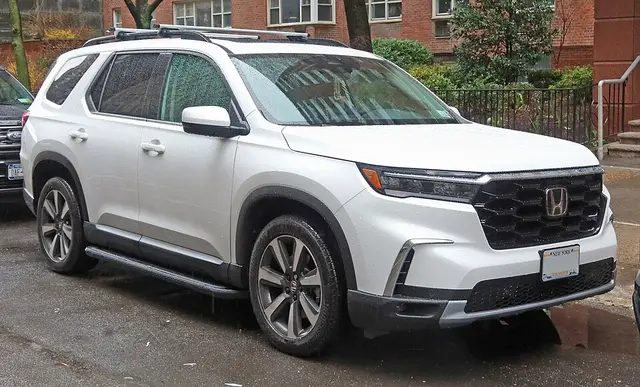
Owners have filed 1,712 complaints with NHTSA about the 2016 Honda Pilot. That is the most of any Pilot model year in the database (24 years). The most reported problem area is engine (771 complaints, 45%), typically at around 61,700 miles. Complaints mention 23 crashes, 10 fires, 20 injuries. There are 8 safety recalls covering this model year. NHTSA has opened 4 defect investigations involving it.

- 1,712owner complaints
- 8safety recalls
- 4NHTSA investigations
- 23complaints mentioning a crash
Complaints are unverified owner reports and are not adjusted for sales volume.
Most common 2016 Honda Pilot problems
Complaints grouped by the part of the car owners reported, with the median mileage when the problem happened.
| Problem area | Complaints | Share | Median miles | Owners mention most | Typical repair cost |
|---|---|---|---|---|---|
| Engine problems | 771 | 45% | 61,700 | “rod bearing” (14%) | $8,900 |
| Electrical System problems | 579 | 34% | 49,008 | “keyless start” (30%) | $710 |
| Unknown or Other | 291 | 17% | 42,000 | — | — |
| Power Train problems | 201 | 12% | 47,500 | “transmission fluid” (9%) | $8,750 |
| Fuel/propulsion System problems | 171 | 10% | 51,000 | “fuel injectors” (27%) | $1,950 |
| Structure problems | 54 | 3% | 15,000 | “fly off” (9%) | — |
| Engine and Engine Cooling | 45 | 3% | 118,003 | — | — |
| Vehicle Speed Control | 39 | 2% | 31,000 | — | — |
| Electronic Stability Control (esc) | 37 | 2% | 37,000 | — | — |
| Service Brakes | 29 | 2% | 15,000 | — | — |
| Forward Collision Avoidance | 25 | 1% | 44,954 | — | — |
| Fuel System, Gasoline | 19 | 1% | 124,000 | — | — |
| Steering | 18 | 1% | 21,000 | — | — |
| Air Bags | 14 | 1% | 57,165 | — | — |
| Exterior Lighting | 14 | 1% | 10,100 | — | — |
| Suspension | 14 | 1% | 16,750 | — | — |
| Lane Departure | 11 | 1% | 61,000 | — | — |
| Wheels | 11 | 1% | 24,000 | — | — |
| Visibility/wiper | 9 | 1% | 35,650 | — | — |
| Seats | 8 | 0% | 35,000 | — | — |
| Seat Belts | 6 | 0% | 16,000 | — | — |
| Back Over Prevention | 5 | 0% | 95,000 | — | — |
| Latches/locks/linkages | 4 | 0% | 104,241 | — | — |
| Visibility | 4 | 0% | 35,000 | — | — |
| Equipment | 3 | 0% | 100 | — | — |
| Service Brakes, Hydraulic | 2 | 0% | 51,185 | — | — |
| Tires | 2 | 0% | 24,000 | — | — |
One complaint can list several problem areas, so shares can add up to more than 100%.
Complaints by year received
2016 Honda Pilot recalls (8)
Tap a recall to see the problem, the risk and the fix.
Structure:frame and members; suspension:rear
Problem: American Honda Motor Company (Honda) is recalling certain 2016-2022 Honda Pilot, 2017-2023 Ridgeline, 2019-2023 Passport, and 2014-2020 Acura MDX vehicles that were sold in Connecticut, Delaware, District of Columbia, Illinois, Indiana, Iowa, Kentucky, Maine, Maryland, Massachusetts, Michigan, Minnesota, Missouri, New Hampshire, New Jersey, New York, Ohio, Pennsylvania, Rhode Island, Vermont, Virginia, West Virginia, or Wisconsin. The rear subframe may corrode at the suspension mounting points, which can result in rear suspension component failure.
Risk: Failure of rear suspension components, such as the rear control arm, can cause a loss of vehicle handling and control, increasing the risk of a crash or injury.
Fix: Dealers will inspect the rear subframe and install a rear subframe reinforcement kit and, as necessary, repair or replace the rear subframe components, free of charge. Interim letters notifying owners of the safety risk were mailed July 27, 2026. Additional letters will be sent once the final remedy is available, anticipated in the fall of 2026. Owners may contact Honda's customer service at 1-888-234-2138. Honda's numbers for this recall are AOU and AOT. Vehicle Identification Numbers (VINs) involved in this recall will become searchable on NHTSA.gov beginning June 10, 2026.
Fuel system, gasoline:delivery:fuel pump
Problem: Honda (American Honda Motor Co.) is recalling certain 2013-2023 Honda Accord, Civic Coupe, Civic Sedan, Civic Hatchback, Civic Type R, CR-V, HR-V, Ridgeline, Odyssey, Acura ILX, MDX, MDX Hybrid, RDX, RLX, TLX, 2019-2022 Honda Insight, Passport, 2020 Honda CR-V Hybrid, 2018-2019 Honda Clarity PHEV, Fit, and 2015-2020 Honda Accord Hybrid, Pilot, Acura NSX vehicles. The fuel pump inside the fuel tank may fail.
Risk: Fuel pump failure can cause an engine stall while driving, increasing the risk of a crash.
Fix: Dealers will replace the fuel pump module, free of charge. Owner letters were mailed September 6, 2024. Owners may contact Honda customer service at 1-888-234-2138. Honda's numbers for this recall are KGC and KGD. This recall is an expansion of NHTSA recall numbers 21V-215 and 20V-314.
Engine and engine cooling:engine:hard parts internal/mechanical
Problem: Honda (American Honda Motor Co.) is recalling certain 2015-2020 Acura TLX, 2016-2020 Acura MDX, 2016 and 2018-2019 Pilot, 2017 and 2019 Ridgeline, and 2018-2019 Odyssey vehicles. Due to a manufacturing error, the connecting rod bearing in the engine may wear and seize, damaging the engine.
Risk: A damaged engine may run improperly or stall while driving, increasing the risk of a fire, crash, or injury.
Fix: Dealers will inspect and repair, or replace the engine as necessary, free of charge. Owner letters were mailed March 28, 2024. 2016-2017 Acura MDX owner letters were mailed November 1, 2024. 2016-2020 Acura MDX owner letters are expected to be mailed in mid-December 2024. Honda began mailing owner notification letters as of March 18, 2024. 2015-2016 Acura owner letters are expected to be mailed mid-December 2024, 2018 Acura TLX owner letters are expected to be mailed the end of March/early April 2024, 2019 Acura TLX owner letters are expected to be mailed mid-May 2024, 2020 Acura TLX owner letters are expected to be mailed mid-June 2024, and 2016-2020 Acura MDX owner letters are expected to be mailed January 27, 2025. Owners may contact Honda customer service at 1-888-234-2138. Honda's numbers for these recalls are XG1 and GG0.
Latches/locks/linkages:hood:latch; structure:body:hood
Problem: Honda (American Honda Motor Co.) is recalling certain 2019 Passport, 2016-2019 Pilot, and 2017-2020 Ridgeline vehicles. The hood latch striker may become damaged and separate from the hood, which can result in the hood opening while driving.
Risk: A hood that opens while driving can obstruct the driver's view and increase the risk of a crash.
Fix: Dealers will either repair the hood latch striker, or replace the hood if necessary, free of charge. Owner notification letters were mailed January 18, 2022. Owners may contact Honda customer service at 1-888-234-2138. Honda's number for this recall is PBV.
Fuel system, gasoline:storage
Problem: Honda (American Honda Motor Co.) is recalling certain 2016 Honda Pilot 2WD and AWD vehicles. The affected vehicles have fuel tanks that may leak.
Risk: A fuel leak in the presence of an ignition source can increase the risk of a fire.
Fix: Honda will notify owners, and dealers will replace the fuel tank, free of charge. Owners may contact Honda customer service at 1-888-234-2138. Honda's number for this recall is KE8.
Fuel system, gasoline:storage:tank assembly
Problem: Honda (American Honda Motor Co.) is recalling certain model year 2015 Acura MDX 2WD and MDX 4WD vehicles, 2016 Acura MDX 4WD vehicles, 2015-2016 Honda Odyssey vehicles, and 2016 Honda Pilot 2WD and 4WD vehicles. The affected vehicles have fuel tanks that were manufactured with insufficient welds which may separate and allow fuel to leak out.
Risk: A fuel leak in the presence of an ignition source may result in a fire.
Fix: Honda will notify owners, and dealers will replace the fuel tanks, free of charge. Owners may contact Honda/Acura customer service at 1-888-234-2138. The recall began on July 29, 2016. Honda's numbers for this recall are KA9 (Honda vehicles) and KB0 (Acura vehicles).
Electrical system: instrument cluster/panel
Problem: Honda (American Honda Motor Co.) is recalling certain model year 2016 Honda Pilot 2WD vehicles manufactured May 4, 2015, to September 8, 2015 and 2016 Pilot 4WD vehicles manufactured May 7, 2015 to September 4, 2015. In the affected vehicles, when one of the safety systems such as tire pressure monitoring, anti-lock braking or electronic stability control malfunctions, there is potential that the instrument panel will not illuminate the corresponding warning light, however the warning lamps will illuminate when the ignition is turned off and then turned back on. As such, these vehicles fail to comply with the requirements of Federal Motor Vehicle Safety Standard (FMVSS) number 126, "Electronic stability control systems", number 135, "Light vehicle brake systems" and number 138, "Tire pressure monitoring systems".
Risk: If a safety system cannot immediately warn the driver when needed, the driver may be at increased risk of a crash.
Fix: Honda will notify owners, and dealers will update the instrument cluster software, free of charge. The recall began on December 11, 2015. Owners may contact Honda customer service at 1-888-234-2138. Honda's number for this recall is JV7.
Seat belts:rear/other
Problem: Honda (American Honda Motor Co.) is recalling certain model year 2016 Honda Pilot vehicles manufactured May 4, 2015, to June 5, 2015. Due to an assembly issue, the third row seatbelt may be trapped between the rear seat and the rear sideliner.
Risk: If the third row seatbelt is trapped, the occupants may not be restrained properly, increasing the risk of injury.
Fix: Honda will notify owners, and dealers will inspect and repair the rear third row seat belt, free of charge. The recall began on August 6, 2015. Owners may contact Honda customer service at 1-310-783-2000. Honda's number for this recall is JS7.
To see whether a specific car still has an open recall, enter its VIN on NHTSA's official recall lookup. You can also decode a VIN here.
NHTSA defect investigations
- Engine failure (PE25008) — opened Aug 20, 2025, still open.
- No Restart After Auto Start/Stop Engages (EA25004) — opened Mar 26, 2025, still open.
- Engine failure (RQ24013) — opened Nov 8, 2024, closed Aug 20, 2025.
- No Restart After Auto Start/Stop Engages (PE22005) — opened Jun 3, 2022, closed Mar 26, 2025.
Recent owner reports
Short excerpts of the latest complaints filed with NHTSA, with personal details removed. Full reports can be searched on NHTSA.gov.
The contact owns a 2016 Honda Pilot. The contact received notification of NHTSA Campaign Number: 26V365000 (Structure, Suspension); however, the front subframe had a hole caused by corrosion. The contact stated that while driving approximately 5-10 MPH, the front end of the vehicle made clunking…
The contact's company owns a 2016 Honda Pilot. The contact stated that vehicle failed to start after several attempts with the "Emission System Failure", "Trailer Stability Assist", and "Electric Power Steering messages were displayed. Due to the failure, the vehicle was towed to an independent…
We have a 2016 Honda pilot. The front fuel rail assembly which included the fuel rail pressure sensor & the high pressure fuel pump had to be replaced in our vehicle and it is currently going to the mechanic shop for the low pressure pump to now be replaced as well. There have been multiple…
Catastrophic internal engine mechanical failure. My 2016 Honda Pilot (3.5L V6 engine) has developed a severe connecting rod bearing knock that is highly audible during cold starts and heavily intensifies upon pressing the gas pedal to accelerate. This issue is an exact match to the mechanical…
My 2016 honda pilot has 97,500 miles. The engine stop working and I have it replaced a used 3.5 engine. The transmission has transmission overheating problem and I took a picture on the dash board. I show it to the service advisor and they won't acknowledge about the overheating problem. Honda care…
Other Honda Pilot years
| Year | Complaints | Recalls |
|---|---|---|
| 2026 Pilot | 23 | 1 |
| 2025 Pilot | 209 | 4 |
| 2024 Pilot | 116 | 6 |
| 2023 Pilot | 146 | 5 |
| 2022 Pilot | 164 | 5 |
| 2021 Pilot | 443 | 10 |
| 2020 Pilot | 492 | 11 |
| 2019 Pilot | 912 | 13 |
| 2018 Pilot | 440 | 7 |
| 2017 Pilot | 933 | 4 |
| 2016 | 1,712 | 8 |
| 2015 Pilot | 109 | 4 |
| 2014 Pilot | 116 | 3 |
| 2013 Pilot | 271 | 6 |
| 2012 Pilot | 171 | 9 |
| 2011 Pilot | 293 | 11 |
| 2010 Pilot | 111 | 10 |
| 2009 Pilot | 134 | 9 |
| 2008 Pilot | 133 | 7 |
| 2007 Pilot | 211 | 7 |
| 2006 Pilot | 268 | 8 |
| 2005 Pilot | 679 | 13 |
| 2004 Pilot | 544 | 12 |
| 2003 Pilot | 720 | 13 |
See all Honda Pilot problems by year, every Honda model, or the Honda VIN decoder.
Similar Honda models
Embed this 2016 Honda Pilot badge on your site
Copy this code into your blog or forum post. It shows live complaint and recall counts and links back here.
Frequently asked questions
What are the most common problems with the 2016 Honda Pilot?
Owners most often report engine, electrical system, unknown or other problems. The top one, engine, accounts for 771 complaints.
Was there a recall on the 2016 Honda Pilot?
Yes, 8 safety recalls. Enter your VIN at NHTSA.gov to check whether the repairs were done on your car.
Was the 2016 Honda Pilot a good year?
Complaint data can't fully answer that, because counts aren't adjusted for sales. Compared with other Pilot model years, the 2016 has far more complaints than most years, and NHTSA rates it 5 out of 5 stars overall in crash tests. Always get a pre-purchase inspection and check the VIN for open recalls.