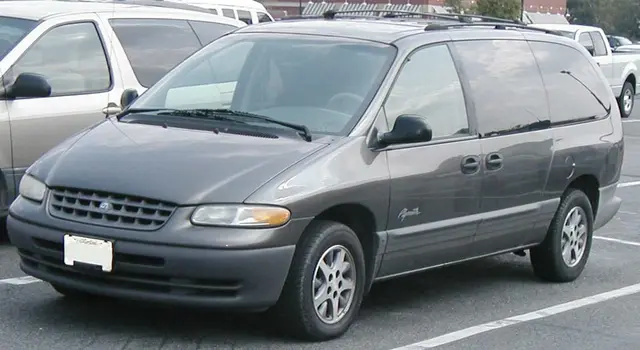
1996 Plymouth Voyager Problems, Complaints & Recalls
- Compared with other Voyager years
- Far more complaints than other years 1st of 6 for complaints
- Safety recalls
- 9 recalls: check your VIN
- NHTSA crash rating
- Not rated
Owners have filed 756 complaints with NHTSA about the 1996 Plymouth Voyager. That is the most of any Voyager model year in the database (6 years). The most reported problem area is engine and engine cooling (136 complaints, 18%), typically at around 93,547 miles. Complaints mention 36 crashes, 30 fires, 36 injuries. There are 9 safety recalls covering this model year. NHTSA has opened 14 defect investigations involving it.

- 756owner complaints
- 9safety recalls
- 14NHTSA investigations
- 36complaints mentioning a crash
Complaints are unverified owner reports and are not adjusted for sales volume.
Most common 1996 Plymouth Voyager problems
Complaints grouped by the part of the car owners reported, with the median mileage when the problem happened.
| Problem area | Complaints | Share | Median miles | Owners mention most | Typical repair cost |
|---|---|---|---|---|---|
| Engine and Engine Cooling problems | 136 | 18% | 93,547 | “head gasket” (10%) | — |
| Air Bags problems | 134 | 18% | 100,000 | “air bag” (43%) | — |
| Electrical System problems | 114 | 15% | 92,625 | “clock spring” (14%) | — |
| Fuel System, Gasoline problems | 99 | 13% | 100,000 | “fuel tank” (42%) | — |
| Power Train problems | 88 | 12% | 72,000 | “transmission failed” (17%) | — |
| Visibility problems | 80 | 11% | 94,000 | “windshield wipers” (51%) | — |
| Service Brakes, Hydraulic problems | 57 | 8% | 65,660 | “abs brakes” (11%) | — |
| Vehicle Speed Control | 48 | 6% | 103,389 | — | — |
| Structure | 38 | 5% | 138,500 | — | — |
| Steering | 33 | 4% | 63,320 | — | — |
| Equipment | 32 | 4% | 65,660 | — | — |
| Latches/locks/linkages | 29 | 4% | 73,000 | — | — |
| Child Seat | 26 | 3% | — | — | — |
| Seat Belts | 24 | 3% | 100,000 | — | — |
| Suspension | 24 | 3% | 116,250 | — | — |
| Exterior Lighting | 18 | 2% | 111,500 | — | — |
| Seats | 16 | 2% | 100,000 | — | — |
| Unknown or Other | 13 | 2% | 950,000 | — | — |
| Fuel System, Other | 9 | 1% | 19,000 | — | — |
| Tires | 6 | 1% | 118,000 | — | — |
| Parking Brake | 5 | 1% | — | — | — |
| Interior Lighting | 3 | 0% | — | — | — |
| Wheels | 3 | 0% | — | — | — |
| Engine | 1 | 0% | 95,000 | — | — |
| Service Brakes, Air | 1 | 0% | — | — | — |
One complaint can list several problem areas, so shares can add up to more than 100%.
Complaints by year received
1996 Plymouth Voyager recalls (9)
Tap a recall to see the problem, the risk and the fix.
Air bags:frontal
Problem: On certain mini vans, the clockspring assembly may have been wound incorrectly during the vehicle assembly process.
Risk: This condition will manifest itself through illumination of the air bag warning lamp, and could eventually result in a driver's air bag open circuit, if the part is not replaced in a reasonable amount of time.
Fix: Dealers will replace the clockspring assembly on all vehicles with 70,000 miles or less. An extended lifetime warranty will also be placed on this component for all affected vehicles, regardless of mileage. Daimlerchrysler will also reimburse owners who have paid to have the clockspring replaced on their vehicles. Owner notification began november 18, 2002. Owners who take their vehicles to an authorized dealer on an agreed upon service date and do not receive the free remedy within a reasonable time should contact daimlerchrysler at 1-800-853-1403.
Fuel system, gasoline:fuel injection system
Problem: Vehicle description: mini vans built with 3.3l and 3.8l engines have fuel rails with nitrole rubber o-ring seals that can degrade over time. Fuel leakage from the underhood fuel injection fuel rail could result, increasing the likelihood of a vehicle fire.
Risk: Fuel leakage in the presence of an ignition source can result in a fire.
Fix: Dealers will install a seal on the vehicle fuel rails to prevent external leakage of fuel from the fuel rail crossover tube, should the existing o-rings continue to degrade. Owner notification began on january 25, 2002. Due to the large quantity of vehicles involved in this campaign, the owner notification will be phased over the next several months. However, if a vehicle is leaking fuel from the o-rings, the vehicle should be taken into a dealer to have this repaired as soon as possible. Owners who take their vehicles to an authorized dealer on an agreed upon service date and do not receive the free remedy within a reasonable time should contact daimlerchrysler at 1-800-853-1403.
Fuel system, gasoline:delivery:fuel pump
Problem: Vehicle description: minivans. Fuel can leak from the fuel tank at the interface of the fuel pump module attachment.
Risk: If a fuel leak occurs in the presence of an ignition source, a fire could occur.
Fix: Dealers will replace the fuel pump module attaching nut with a nut that includes tighter design tolerances. The sealing o-ring will also be replaced.
Child seat
Problem: Vehicle description: mini vans equipped with integrated child seats. The shoulder harness restraint on the integrated child seat can become difficult to extract when the safety belt latch plate becomes contaminated.
Risk: This can cause difficulty in releasing a child from the restraint.
Fix: Dealers will clean the latch mechanism. An extender will be added to the emergency release anchor for the child seat safety belts so that the release clips are more visible and accessible to the operator in the event that the retractor mechanism can not be unlocked. In addition, an instructional owner's manual supplement card will be provided.
Seat belts:integrated child seat
Problem: The bolts which secure the integrated child seat modules to the seat frame can break.
Risk: In the event of a vehicle accident, the child seat may not provide adequate protection to the occupant.
Fix: Dealers will replace the integrated child seat module bolts.
Fuel system, gasoline:storage:tank assembly:filler pipe and cap
Problem: A static electric charge can build up on the ungrounded metal section of the fuel filler tube.
Risk: This condition could cause a spark to occur when fueling the vehicle and possibly ignite the fuel vapors.
Fix: Dealers will install a ground strap for the fuel filler tube.
Engine and engine cooling:engine:gasoline
Problem: In certain vehicles, the engine cylinder head oil galley plug does not seal properly and engine cylinder head oil is not adequately retained.
Risk: Inadequate sealing and retention of the plug can result in oil leakage which could cause a fire in the engine compartment.
Fix: Dealers will install an expansion plug and retaining bracket over the cylinder head oil galley plug.
Fuel system, gasoline:delivery:hoses, lines/piping, and fittings
Problem: The fuel tank rollover valve can allow fuel to pass into the vapor canister resulting in the potential for fuel leakage.
Risk: Fuel leakage increases the potential for a vehicle fire.
Fix: Dealers will replace the fuel tank filler tube with a filler tube that has an additional rollover valve. The associated rollover valve vapor hoses will be rerouted.
Seats
Problem: The bolts which secure the rear bench seats to the seat risers may be embrittled and fracture.
Risk: In case of an accident, the bolt may fail and can cause the seat to break away from the seat risers, which increases the potentialof injury to its occupants.
Fix: Dealers will replace the rear bench seat to riser bolts.
To see whether a specific car still has an open recall, enter its VIN on NHTSA's official recall lookup. You can also decode a VIN here.
NHTSA defect investigations
- Defective air bag crash sensor (DP96014) — opened Nov 14, 1996, still open.
- Air bag clockspring (EA01007) — opened Feb 21, 2001, closed Nov 22, 2002, led to recall 02V293000.
- Air bag clockspring (PE00032) — opened Aug 8, 2000, closed Feb 21, 2001, led to recall 02V293000.
- Dc minivan fuel injector rail leak (RQ00008) — opened Mar 9, 2000, closed Mar 18, 2002, led to recall 00V268000.
- Post collision fuel system (EA99013) — opened Jun 11, 1999, closed Aug 10, 2001.
- Post-collision fuel system integrity (PE99010) — opened Feb 3, 1999, closed Jun 11, 1999.
- Fuel tank leaks (EA97002) — opened Jan 31, 1997, closed Feb 10, 1998.
- Integrated child seat belt lockup (EA97003) — opened Jan 31, 1997, closed Aug 19, 1998, led to recall 97I001000.
- Sliding door latch failure (EA96025) — opened Oct 15, 1996, closed Jul 30, 1998.
- Integrated child seat belt lockup (SQ96016) — opened Sep 18, 1996, closed Feb 4, 1997.
- Fuel leaks from the gas tank (PE96051) — opened Aug 19, 1996, closed Jan 31, 1997, led to recall 99V216000.
- Sliding door latch failure (PE96038) — opened May 16, 1996, closed Oct 15, 1996.
- Safety blt latch operation (PE96008) — opened Jan 25, 1996, closed Jun 28, 1996.
- Fuel leakeage from rollover valve (PE95053) — opened Oct 25, 1995, closed Dec 22, 1995, led to recall 95V236000.
Recent owner reports
Short excerpts of the latest complaints filed with NHTSA, with personal details removed. Full reports can be searched on NHTSA.gov.
Tl* the contact owns a 1996 plymouth voyager. The contact stated that the air bag warning indicator remained illuminated while driving and the cruise control and horn failed to function. In addition, when making a turn, there was a flapping noise in the steering wheel that caused the clock spring…
Tl* the contact owns a 1996 plymouth voyager. When starting the vehicle, there was an abnormal snapping noise heard from the vehicle. The contact shifted into drive; however, the vehicle would not move forward. When the shifter was placed in reverse, the vehicle would only move backwards but not…
Tl* the contact owns a 1996 plymouth voyager. The contact stated the engine oil leaked excessively from the vehicle, which required oil to be added to the reservoir every four days. The contact referenced nhtsa campaign id number: 96v006000 (engine and engine cooling:engine:gasoline) however, the…
Tl*the contact owns a 1996 plymouth voyager. The contact stated that while driving 30 mph, he smelled a fuel odor. The contact noticed a fuel leak from the rear of the fuel tank. The dealer stated that the fuel module needed to be replaced. The vehicle had not been repaired. The current and failure…
Tl*the contact owns a 1996 dodge plymouth voyageer when the vehicle was started, the front windshield wipers operated without being activated. Moments later, the wipers would shut off on their own. In cold temperatures, the windshield wipers would become stuck to the front windshield. There were no…
Other Plymouth Voyager years
← 1995 Voyager · 1997 Voyager →
| Year | Complaints | Recalls |
|---|---|---|
| 2000 Voyager | 168 | 2 |
| 1999 Voyager | 273 | 4 |
| 1998 Voyager | 323 | 5 |
| 1997 Voyager | 346 | 6 |
| 1996 | 756 | 9 |
| 1995 Voyager | 336 | 1 |
See all Plymouth Voyager problems by year, every Plymouth model, or the VIN decoder.
Similar Plymouth models
Embed this 1996 Plymouth Voyager badge on your site
Copy this code into your blog or forum post. It shows live complaint and recall counts and links back here.
Frequently asked questions
What are the most common problems with the 1996 Plymouth Voyager?
Owners most often report engine and engine cooling, air bags, electrical system problems. The top one, engine and engine cooling, accounts for 136 complaints.
Was there a recall on the 1996 Plymouth Voyager?
Yes, 9 safety recalls. Enter your VIN at NHTSA.gov to check whether the repairs were done on your car.
Was the 1996 Plymouth Voyager a good year?
Complaint data can't fully answer that, because counts aren't adjusted for sales. Compared with other Voyager model years, the 1996 has far more complaints than most years. Always get a pre-purchase inspection and check the VIN for open recalls.