2018 Tesla Model X Problems, Complaints & Recalls
- Compared with other Model X years
- More complaints than other years 4th of 12 for complaints
- Safety recalls
- 9 recalls: check your VIN
- NHTSA crash rating
- Not rated
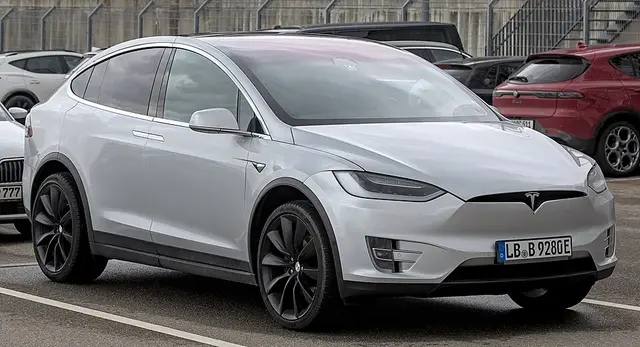
Owners have filed 193 complaints with NHTSA about the 2018 Tesla Model X. That ranks 4th out of 12 Model X model years for complaints. The most reported problem area is unknown or other (41 complaints, 21%), typically at around 11,700 miles. Complaints mention 35 crashes, 2 fires, 16 injuries. There are 9 safety recalls covering this model year. NHTSA has opened 16 defect investigations involving it.

- 193owner complaints
- 9safety recalls
- 16NHTSA investigations
- 35complaints mentioning a crash
Complaints are unverified owner reports and are not adjusted for sales volume.
Most common 2018 Tesla Model X problems
Complaints grouped by the part of the car owners reported, with the median mileage when the problem happened.
| Problem area | Complaints | Share | Median miles | Owners mention most | Typical repair cost |
|---|---|---|---|---|---|
| Unknown or Other | 41 | 21% | 11,700 | — | — |
| Suspension | 37 | 19% | 14,000 | — | — |
| Electrical System | 36 | 19% | 9,550 | — | — |
| Forward Collision Avoidance | 32 | 17% | 38,500 | — | — |
| Structure | 22 | 11% | 7,650 | — | — |
| Vehicle Speed Control | 19 | 10% | 9,200 | — | — |
| Steering | 18 | 9% | 100,000 | — | — |
| Service Brakes | 14 | 7% | 3,150 | — | — |
| Power Train | 11 | 6% | 89,806 | — | — |
| Seats | 11 | 6% | 38,454 | — | — |
| Air Bags | 8 | 4% | 1,500 | — | — |
| Seat Belts | 8 | 4% | 27,000 | — | — |
| Lane Departure | 7 | 4% | — | — | — |
| Wheels | 6 | 3% | 7,084 | — | — |
| Tires | 5 | 3% | 4,280 | — | — |
| Fuel/propulsion System | 4 | 2% | 1,500 | — | — |
| Engine | 3 | 2% | 1,000 | — | — |
| Visibility/wiper | 3 | 2% | 17,500 | — | — |
| Electronic Stability Control (esc) | 2 | 1% | 2,900 | — | — |
| Exterior Lighting | 2 | 1% | 26,000 | — | — |
| Latches/locks/linkages | 2 | 1% | — | — | — |
| Communication | 1 | 1% | 47,300 | — | — |
One complaint can list several problem areas, so shares can add up to more than 100%.
Complaints by year received
2018 Tesla Model X recalls (9)
Tap a recall to see the problem, the risk and the fix.
Seat belts:front:warning light/devices
Problem: Tesla, Inc. (Tesla) is recalling certain 2012-2024 Model S, 2015-2024 Model X, 2017-2023 Model 3, and 2020-2023 Model Y vehicles. In the event of an unbelted driver, the seat belt warning light and audible chime may not activate as intended. As such, these vehicles fail to comply with the requirements of Federal Motor Vehicle Safety Standard number 208, "Occupant Crash Protection."
Risk: A seat belt warning system that fails to alert occupants of an unbelted seat belt can increase the risk of injury during a crash.
Fix: Tesla will release an over-the-air (OTA) software update. Owner notification letters were mailed July 26, 2024. Owners may contact Tesla customer service at 1-877-798-3752. Tesla's number for this recall is SB-24-00-008.
Electrical system: instrument cluster/panel
Problem: Tesla, Inc. (Tesla) is recalling certain 2012-2023 Model S, 2016-2024 Model X, 2017-2023 Model 3, 2019-2024 Model Y, and 2024 Cybertruck vehicles. An incorrect font size is displayed on the instrument panel for the Brake, Park, and Antilock Brake System (ABS) warning lights. As such, these vehicles fail to comply with the requirements of Federal Motor Vehicle Safety Standard number 105, "Hydraulic and Electric Brake Systems" and 135, "Light Vehicle Brake Systems."
Risk: Warning lights with a smaller font size can make critical safety information on the instrument panel difficult to read, increasing the risk of a crash.
Fix: Tesla began releasing an over-the-air (OTA) software update, free of charge. Owners may contact Tesla customer service at 1-877-798-3752. Tesla's number for this recall is SB-24-00-003.
Electrical system:adas:driver monitoring:software
Problem: Tesla, Inc. (Tesla) is recalling 2012-2023 Model S, 2016-2023 Model X, 2017-2023 Model 3, and 2020-2023 Model Y vehicles equipped with all versions of Autosteer leading up to the version(s) that contains the recall remedy. In certain circumstances when Autosteer is engaged, the prominence and scope of the feature's controls may not be sufficient to prevent driver misuse of the SAE Level 2 advanced driver-assistance feature.
Risk: In certain circumstances when Autosteer is engaged, and the driver does not maintain responsibility for vehicle operation and is unprepared to intervene as necessary or fails to recognize when Autosteer is canceled or not engaged, there may be an increased risk of a crash.
Fix: Tesla will release an over-the-air (OTA) software update, free of charge. Owner notification letters were mailed February 10, 2024. Owners may contact Tesla customer service at 1-877-798-3752. Tesla's number for this recall is SB-23-00-008.
Steering:automated/adaptive steering
Problem: Tesla, Inc. (Tesla) is recalling certain 2016-2023 Model S, Model X, 2017-2023 Model 3, and 2020-2023 Model Y vehicles equipped with Full Self-Driving Beta (FSD Beta) software or pending installation. The FSD Beta system may allow the vehicle to act unsafe around intersections, such as traveling straight through an intersection while in a turn-only lane, entering a stop sign-controlled intersection without coming to a complete stop, or proceeding into an intersection during a steady yellow traffic signal without due caution. In addition, the system may respond insufficiently to changes in posted speed limits or not adequately account for the driver's adjustment of the vehicle's speed to exceed posted speed limits.
Risk: FSD Beta software that allows a vehicle to exceed speed limits or travel through intersections in an unlawful or unpredictable manner increases the risk of a crash.
Fix: Tesla will release an over-the-air (OTA) software update, free of charge. Owner notification letters were mailed April 15, 2023. Owners may contact Tesla customer service at 1-877-798-3752. Tesla's number for this recall is SB-23-00-001.
Steering:electric power assist system
Problem: Tesla, Inc. (Tesla) is recalling certain 2017-2021 Model S and Model X vehicles. The electronic power assist steering (EPAS) system may experience a loss of power steering assist when driving on rough roads or after hitting a pothole.
Risk: A loss of power steering assist can require greater steering effort, especially at low speeds, increasing the risk of a crash.
Fix: Tesla has released an over-the-air (OTA) software update to recalibrate the EPAS system, free of charge. Owner notification letters were mailed December 31, 2022. Owners may contact Tesla customer service at 1-877-798-3752. Tesla's number for this recall is SB-22-00-014.
Back over prevention:display function
Problem: Tesla, Inc. (Tesla) is recalling certain 2018-2019 Model S, Model X, and 2017-2020 Model 3 vehicles equipped with Autopilot Computer 2.5 and operating certain firmware releases. The rearview image may not immediately display when the vehicle begins to reverse. As such, these vehicles fail to comply with the requirements of Federal Motor Vehicle Safety Standard number 111, "Rear Visibility."
Risk: A delayed rearview camera image reduces the driver's rear view, increasing the risk of a crash.
Fix: Tesla will perform an over-the-air (OTA) software update, free of charge. Owner notification letters were mailed May 17, 2022. Owners may contact Tesla customer service at 1-877-798-3752. Tesla's number for this recall is SB-22-00-004.
Steering:automated/adaptive steering
Problem: Tesla, Inc. (Tesla) is recalling certain 2016-2022 Model S and Model X, 2017-2022 Model 3, and 2020-2022 Model Y vehicles. The "rolling stop" functionality available as part of the Full Self-Driving (Beta) software may allow the vehicle to travel through an all-way stop intersection without first coming to a stop.
Risk: Failing to stop at a stop sign can increase the risk of a crash.
Fix: Tesla will perform an over-the-air (OTA) software update that disables the "rolling stop" functionality, free of charge. Owner notification letters were mailed March 28, 2022. Owners may contact Tesla customer service at 1-877-798-3752. Tesla's number for this recall is SB-22-00-001.
Forward collision avoidance: sensing system: camera; forward collision avoidance:software; forward collision avoidance: automatic emergency braking; forward collision avoidance: warnings
Problem: Tesla, Inc. (Tesla) is recalling certain 2017-2021 Model S, Model 3, Model X, and 2020-2021 Model Y vehicles operating software version 2021.36.5.2. A communication error may cause false forward-collision warning (FCW) or unexpected activation of the automatic emergency brake (AEB) system.
Risk: Unexpected activation of the AEB system may cause the car to stop suddenly, increasing the risk of a crash.
Fix: Tesla Service has released an over-the-air (OTA) software update, free of charge. The recall began October 25, 2021. Owners may contact Tesla customer service at 1-877-798-3752. Tesla's number for this recall is SB-21-00-004.
Visibility:defroster/defogger/hvac system; exterior lighting:turn signal; back over prevention:software
Problem: Tesla, Inc. (Tesla) is recalling certain 2012-2018 Tesla Model S and 2016-2018 Model X vehicles with a center display equipped with a NVIDIA Tegra 3 processor and an 8GB eMMC NAND flash memory device. When the 8GB eMMC NAND flash memory device for the center display reaches lifetime wear, the eMMC controller will no longer be able to maintain the integrity of the filesystem, causing a failure in some of the center display functions.
Risk: The eMMC controller wear-out condition can cause the loss of the rearview camera display, defrost/defog control settings, and exterior turn signal lighting, reducing visibility and increasing the risk of a crash.
Fix: Owners should ensure their vehicles are operating firmware release 2020.48.48.12 or newer, which will alert owners if the eMMC is approaching lifetime wear. Tesla will notify owners, and will replace the VCM daughterboard with one containing an enhanced eMMC controller, free of charge. The recall began March 29, 2021. Owners may contact Tesla customer service at 1-877-798-3752. Tesla's number for this recall is SB-21-21-001.
To see whether a specific car still has an open recall, enter its VIN on NHTSA's official recall lookup. You can also decode a VIN here.
NHTSA defect investigations
- FSD Collisions in Reduced Roadway Visibility Conditions (EA26002) — opened Mar 18, 2026, still open.
- Traffic safety violations while Full Self Driving ("FSD") is engaged (PE25012) — opened Oct 7, 2025, still open.
- Compliance with Standing General Order 2021-01 Reporting Requirements (AQ25002) — opened Aug 20, 2025, still open.
- Recall 23V838 Remedy Effectiveness (RQ24009) — opened Apr 25, 2024, still open.
- Sudden Unintended Acceleration (DP23002) — opened Jun 29, 2023, still open.
- Desiccated Air Bag Inflator Rupture (EA21002) — opened Sep 17, 2021, still open.
- FSD Collisions in Reduced Roadway Visibility Conditions (PE24031) — opened Oct 17, 2024, closed Mar 18, 2026.
- Defect Petition Interlock Request (DP23001) — opened Apr 7, 2023, closed Mar 18, 2026.
- Pedestrian alert sounds (DP22005) — opened Jan 27, 2023, closed Aug 7, 2023, led to recall 22V063000.
- Autopilot System Driver Controls (EA22002) — opened Jun 8, 2022, closed Apr 25, 2024, led to recall 23V085.
- Tesla Passenger Play (PE21023) — opened Dec 21, 2021, closed May 26, 2023.
- Autopilot & First Responder Scenes (PE21020) — opened Aug 13, 2021, closed Jun 8, 2022.
- Loss of rearview camera (EA20003) — opened Nov 12, 2020, closed May 2, 2024, led to recall 21V035.
- Loss of rearview camera (PE20010) — opened Jun 22, 2020, closed Nov 22, 2020.
- Sudden Unintended Acceleration (DP20001) — opened Jan 13, 2020, closed Jan 8, 2021.
- Battery Management Software Updates (DP19005) — opened Oct 1, 2019, closed Sep 28, 2021.
Recent owner reports
Short excerpts of the latest complaints filed with NHTSA, with personal details removed. Full reports can be searched on NHTSA.gov.
Following battery replacement under Service Order #XXX at a Tesla Service Center, my 2018 Tesla Model X 100D (VIN [XXX]) was returned with the underbody belly pan visibly detached and drooping toward the road surface. Fasteners were not reinstalled after service. Additional post-service issues…
I am reporting a serious FSD safety-related software issue. While FSD was engaged, my 2018 Model X 100D (HW3, software 2026.26.6.1, FSD 12.6.4) unexpectedly came to a complete stop in the middle of the street twice. Please do not treat this as a repair estimate. I am requesting that Tesla review…
The contact owns a 2018 Tesla Model X. The contact stated that while attempting to park the vehicle, the vehicle became stuck in drive(D) and failed to shift to park(P). Due to the failure, the safety system locked the doors, and the contact was trapped inside the vehicle. The front end of the…
My vehicle intermittently and without warning disables Autopilot/cruise control while driving, most consistently during hard acceleration from a stop or low speed. The touchscreen displays "Take Over Immediately" and Autopilot becomes completely unavailable for the remainder of the drive. The…
While driving on FSD (Full Self Driving) the vehicle was turning off the road into a parking lot and sped up and hit a vehicle while I was pressing the brake to the floor! I had to brace for impact when I hit the vehicle. I have requested the data and telemetry logs from Tesla. Everything was fine…
Other Tesla Model X years
← 2017 Model X · 2019 Model X →
| Year | Complaints | Recalls |
|---|---|---|
| 2026 Model X | 7 | 0 |
| 2025 Model X | 16 | 3 |
| 2024 Model X | 27 | 8 |
| 2023 Model X | 194 | 17 |
| 2022 Model X | 128 | 22 |
| 2021 Model X | 41 | 24 |
| 2020 Model X | 128 | 10 |
| 2019 Model X | 101 | 8 |
| 2018 | 193 | 9 |
| 2017 Model X | 268 | 10 |
| 2016 Model X | 450 | 12 |
| 2015 Model X | 0 | 2 |
See all Tesla Model X problems by year, every Tesla model, or the Tesla VIN decoder.
Similar Tesla models
Embed this 2018 Tesla Model X badge on your site
Copy this code into your blog or forum post. It shows live complaint and recall counts and links back here.
Frequently asked questions
What are the most common problems with the 2018 Tesla Model X?
Owners most often report unknown or other, suspension, electrical system problems. The top one, unknown or other, accounts for 41 complaints.
Was there a recall on the 2018 Tesla Model X?
Yes, 9 safety recalls. Enter your VIN at NHTSA.gov to check whether the repairs were done on your car.
Was the 2018 Tesla Model X a good year?
Complaint data can't fully answer that, because counts aren't adjusted for sales. Compared with other Model X model years, the 2018 has more complaints than most years. Always get a pre-purchase inspection and check the VIN for open recalls.